How to Convert SVG to JPG/JPEG: 5 Simple Methods
Complete guide covering 5 methods to convert SVG to JPG/JPEG, from online tools to command line to programming code.
On this page
Advertisement
SVG is the go-to format for scalable vector graphics — logos, icons, illustrations. But not every platform accepts SVG. Social media sites, email clients, content management systems, and many older applications expect JPG (also known as JPEG). If you've ever tried to upload an SVG file only to be told the format isn't supported, you know the frustration.
The good news: converting SVG to JPG is straightforward once you know your options. This guide covers 5 proven methods, from zero-installation online tools to developer-friendly command line utilities. Whether you're a designer, developer, or just someone who needs a quick conversion, you'll find the right approach here.
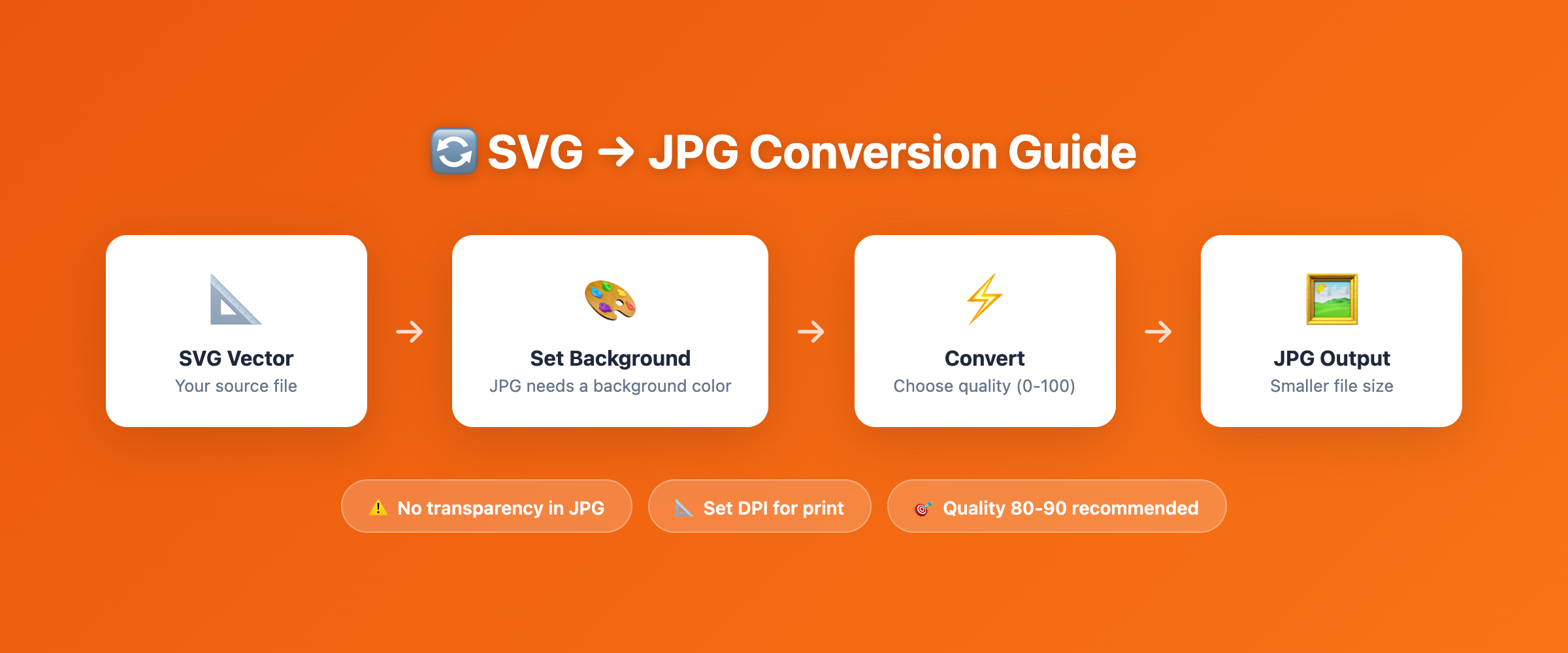
Critical Warning: JPG Does NOT Support Transparency
Before we dive into the methods, there's one thing you absolutely must know:
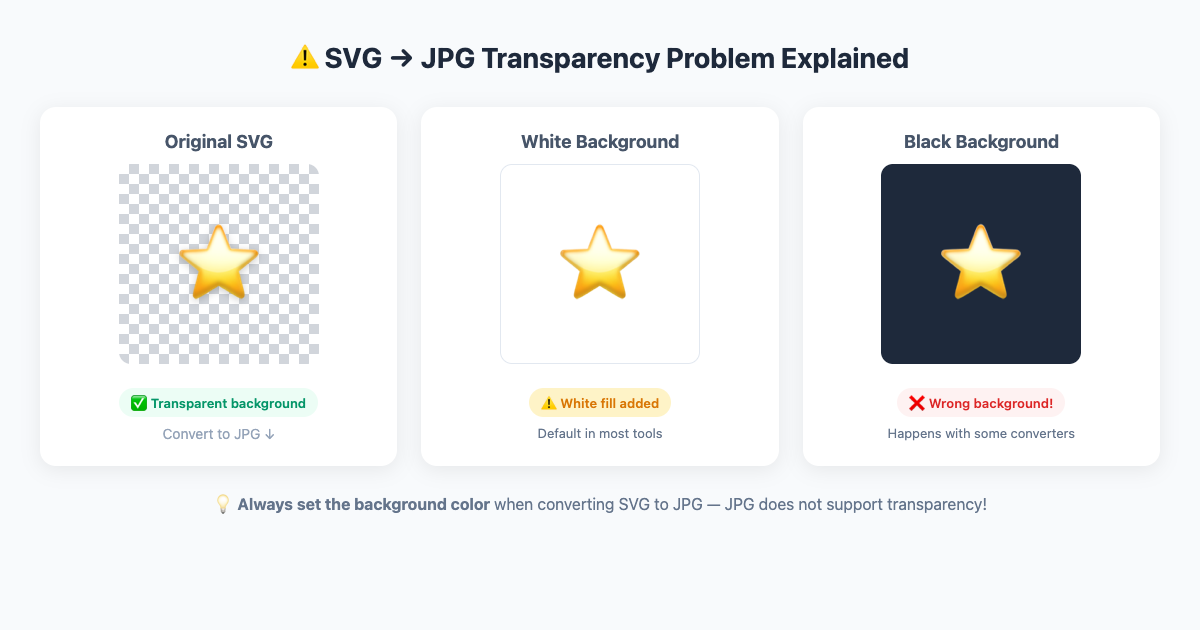
JPG/JPEG does not support transparency. Unlike PNG, which preserves transparent backgrounds, JPG fills transparent areas with a solid color — usually white or black.
When you convert an SVG to JPG, any transparent pixels will be replaced. If your SVG has a transparent background (as most icons and logos do), the result may look quite different from what you expect:
- If the converter defaults to a white background, dark SVG elements on a dark page will suddenly appear inside a white rectangle.
- If the converter defaults to a black background, light elements may become hard to see.
The solution: Always choose a background color explicitly when converting SVG to JPG. Most good converters — including svg2img.cc — let you pick the exact background color before conversion.
When to Choose JPG Over PNG
Both JPG and PNG are raster formats, but they serve different purposes. Here's when JPG is the better choice:
- Photographic content: JPG uses lossy compression that's optimized for photos and complex color gradients. File sizes are significantly smaller than PNG for this type of content.
- Email and social media sharing: JPG's smaller file sizes make it ideal for sending images via email or uploading to platforms with file size limits.
- Website performance: If you're using SVG-derived images as hero banners or background images, JPG can dramatically reduce page load times compared to PNG.
- Universal compatibility: JPG is supported by virtually every device, application, and platform ever made. No format is more universally accepted.
When to stick with PNG instead: if you need transparency, sharp edges (like screenshots or line art), or lossless quality. For a detailed comparison, see our SVG vs PNG guide.
Method 1: Online Converters (Fastest & Easiest)
For most people, an online converter is the quickest path from SVG to JPG. No installation, no setup — just open your browser and convert.
How to Use an Online SVG to JPG Converter
The process takes seconds:
- Open your browser and navigate to a converter tool.
- Load your SVG file (drag and drop, or browse to select).
- Choose your output settings — dimensions, background color, and JPG quality.
- Click convert and download your JPG.
Why We Recommend svg2img.cc
Among online converters, svg2img.cc stands out for one critical reason: your files never leave your browser.
Most online converters upload your file to a remote server, process it there, and send the result back. That means your SVG data — which could contain proprietary logos, design assets, or sensitive information — is transmitted over the internet to a third-party server.
svg2img.cc takes a completely different approach. All conversion happens entirely in your browser using client-side JavaScript. No files are uploaded to any server, ever. This means:
- Total privacy: Your designs stay on your computer. Nothing is sent anywhere.
- Instant speed: No upload/download wait times. Conversion happens in milliseconds.
- Works offline: Once the page loads, you can convert files even without internet.
- No file size limits: Server-based tools often restrict uploads to 5–50 MB. Since everything runs locally, you can convert much larger files.
- Free, with no limits: No daily quotas, no watermarks, no premium tiers.
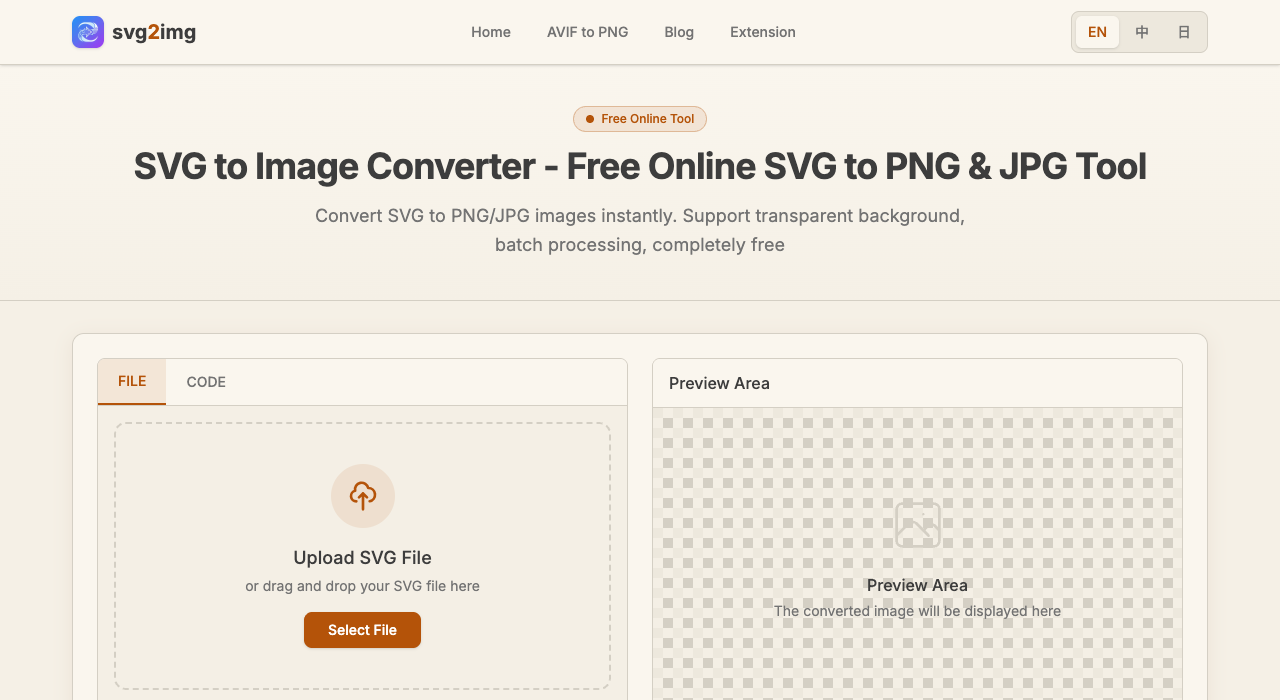
svg2img.cc lets you set custom dimensions, DPI, background color (essential for JPG), and JPG quality level (0–100). It supports output in PNG, JPG, and WebP, giving you full control over the final result.
Method 2: Desktop Software (Best for Professionals)
If you work with graphics regularly, desktop software gives you the most control over the conversion process.
Inkscape (Free & Open Source)
Inkscape is a professional-grade vector graphics editor and one of the best free tools for SVG work.
- Open your SVG file in Inkscape.
- Go to File → Export... (or press
Ctrl+Shift+E). - In the Export dialog, select JPEG from the file format dropdown (supported in Inkscape 1.2+).
- Set your desired dimensions or DPI.
- Click Export to save your JPG.
Note: In older versions of Inkscape (before 1.2), you may need to export as PNG first and then convert to JPG using another tool. However, the latest versions provide a direct and high-quality JPG export.
Adobe Illustrator
For Creative Cloud subscribers, Illustrator offers a streamlined JPG export:
- Open the SVG file in Illustrator.
- Go to File → Export → Export As...
- Choose JPEG as the format.
- In the JPEG options dialog, select:
- Quality: A slider from 0–100 (or Low/Medium/High/Maximum).
- Color mode: RGB for screen, CMYK for print.
- Resolution: Screen (72 PPI), Medium (150 PPI), High (300 PPI).
- Background: Choose a background color — white is the default.
- Click OK to export.
Illustrator gives you fine-grained control over compression quality and background handling, making it ideal for professional work.
Other Desktop Options
- GIMP: Free raster editor that can open SVG files and export as JPG with quality controls.
- Affinity Designer: A paid alternative to Illustrator with robust SVG/JPG export options.
- Photoshop: Open the SVG, rasterize it at your desired resolution, then use File → Export → Export As... and choose JPG.
Method 3: Command Line Tools (Best for Automation)
For developers and power users who need to convert SVG files in bulk or as part of an automated workflow, command line tools are the way to go.
ImageMagick
ImageMagick is a versatile image processing suite available on Linux, macOS, and Windows:
# Basic SVG to JPG conversion
magick -background white input.svg -flatten output.jpg

# Specify dimensions
magick -background white input.svg -resize 1920x1080 -flatten output.jpg

# Set density for print-oriented SVGs that use physical units
magick -density 300 -background white input.svg -flatten output.jpg

# Set JPG quality (0-100, higher = better quality, larger file)
magick -background white input.svg -flatten -quality 90 output.jpg

# Add a white background for transparency (critical for JPG!)
magick -background white input.svg -flatten output.jpg

# Batch convert all SVGs in a directory
for f in *.svg; do magick -background white "$f" -flatten -quality 85 "${f%.svg}.jpg"; done
Note: The examples use ImageMagick 7's magick command. On older ImageMagick 6 installs, the equivalent command may be convert. The -background white -flatten flags are essential for SVG to JPG conversion because JPG does not support transparency.
CairoSVG
CairoSVG is a Python-based SVG converter that can render SVG to PNG, PDF, PS, or SVG. It does not directly write JPG, so use it to create a PNG first, then flatten that PNG onto a solid background and encode the final JPG:
# Install
pip install cairosvg

# Render SVG to PNG first
cairosvg input.svg -o temp.png

# Specify pixel dimensions during the SVG render
cairosvg input.svg -o temp.png --output-width 1920 --output-height 1080

# Flatten the PNG onto a white background and encode JPG
magick temp.png -background white -flatten -quality 90 output.jpg
rsvg-convert (librsvg)
rsvg-convert is often preferred for SVG rendering because it uses librsvg, the renderer used by GNOME and other Linux desktop environments. Like CairoSVG, use it to render an intermediate PNG when your final target is JPG:
# Render SVG to PNG first
rsvg-convert -w 1920 -h 1080 input.svg -o temp.png

# Flatten and encode JPG
magick temp.png -background white -flatten -quality 90 output.jpg

# Batch conversion
for f in *.svg; do
  rsvg-convert -w 1920 "$f" -o "${f%.svg}.png"
  magick "${f%.svg}.png" -background white -flatten -quality 90 "${f%.svg}.jpg"
done
Install on Ubuntu/Debian: sudo apt install librsvg2-bin
Install on macOS: brew install librsvg
Method 4: Programming (JavaScript & Python)
For developers building applications that need SVG-to-JPG conversion, here are programmatic approaches in two popular languages.
JavaScript (Canvas API)
You can convert SVG to JPG entirely in the browser using the Canvas API — this is essentially what browser-based tools like svg2img.cc do under the hood:
async function svgToJpg(svgFile, width, height, quality = 0.92, bgColor = '#ffffff') {
  // Read the SVG file
  const svgText = await svgFile.text();

  // Create an image from the SVG
  const img = new Image();
  const svgBlob = new Blob([svgText], { type: 'image/svg+xml;charset=utf-8' });
  const url = URL.createObjectURL(svgBlob);

  return new Promise((resolve, reject) => {
    img.onload = () => {
      // Create a canvas with desired dimensions
      const canvas = document.createElement('canvas');
      canvas.width = width;
      canvas.height = height;
      const ctx = canvas.getContext('2d');

      // Fill background color (JPG has no transparency!)
      ctx.fillStyle = bgColor;
      ctx.fillRect(0, 0, width, height);

      // Draw the SVG image onto the canvas
      ctx.drawImage(img, 0, 0, width, height);

      // Convert canvas to JPG blob
      canvas.toBlob((blob) => {
        URL.revokeObjectURL(url);
        resolve(blob);
      }, 'image/jpeg', quality);
    };
    img.onerror = reject;
    img.src = url;
  });
}

// Usage
const fileInput = document.querySelector('input[type="file"]');
fileInput.addEventListener('change', async (e) => {
  const file = e.target.files[0];
  const jpgBlob = await svgToJpg(file, 1920, 1080, 0.9, '#ffffff');
  const downloadUrl = URL.createObjectURL(jpgBlob);
  const a = document.createElement('a');
  a.href = downloadUrl;
  a.download = 'output.jpg';
  a.click();
});
The key difference from PNG conversion: ctx.fillStyle = bgColor; ctx.fillRect(...) fills the background before drawing. Without this step, transparent SVG areas become black in the JPG output. The third argument to canvas.toBlob() controls JPG quality (0.0 to 1.0).
Python (CairoSVG + Pillow)
For server-side or automated batch processing, Python offers a robust pipeline:
import cairosvg
from PIL import Image
import io
import os

def convert_svg_to_jpg(input_path, output_path, width=None, height=None,
                        quality=90, bg_color=(255, 255, 255)):
    """Convert a single SVG file to JPG with background color support."""
    # CairoSVG outputs PNG, so we convert via PNG in memory
    png_data = io.BytesIO()
    kwargs = {'write_to': png_data, 'dpi': 300}
    if width:
        kwargs['output_width'] = width
    if height:
        kwargs['output_height'] = height
    cairosvg.svg2png(url=input_path, **kwargs)

    # Open the PNG and convert to JPG with background
    png_data.seek(0)
    img = Image.open(png_data)

    # Handle transparency: composite onto solid background
    if img.mode in ('RGBA', 'LA'):
        background = Image.new('RGB', img.size, bg_color)
        background.paste(img, mask=img.split()[-1])  # Use alpha channel as mask
        img = background
    else:
        img = img.convert('RGB')

    img.save(output_path, 'JPEG', quality=quality)

def batch_convert(input_dir, output_dir, width=1920, quality=85):
    """Convert all SVG files in a directory to JPG."""
    os.makedirs(output_dir, exist_ok=True)
    for filename in os.listdir(input_dir):
        if filename.endswith('.svg'):
            input_path = os.path.join(input_dir, filename)
            output_path = os.path.join(output_dir, filename.replace('.svg', '.jpg'))
            convert_svg_to_jpg(input_path, output_path, width=width, quality=quality)
            print(f"Converted: {filename}")

# Usage
batch_convert('./svg-icons', './jpg-icons', width=1920, quality=85)
This approach handles the transparency-to-background conversion properly by detecting RGBA images and compositing them onto a solid white (or custom color) background.
Method 5: Design Tools (Figma, Canva, Sketch)
If you're already working in a design tool, you can export SVG to JPG without leaving your workflow.
Figma
Figma has become the go-to design tool for many teams:
- Import your SVG file into a Figma project (drag and drop onto the canvas).
- Select the frame or element you want to export.
- In the right sidebar, scroll to the Export section.
- Click the + button to add an export setting.
- Choose JPG as the format.
- Set the export scale (1x, 2x, 3x, 4x) or enter a custom width.
- Click Export and choose where to save the file.
Figma also supports exporting multiple sizes at once — useful for generating variants for different display densities.
Canva
Canva is incredibly popular for social media and marketing design:
- Create a new design or open an existing one.
- Upload your SVG file via the Uploads tab in the left panel.
- Add the SVG to your canvas.
- Click Share → Download in the top right.
- Select JPG as the file type.
- Choose your desired quality settings.
- Click Download.
Note: Canva's free tier has some export restrictions. For unlimited, high-resolution JPG exports, a Canva Pro subscription may be needed.
Sketch (macOS Only)
For Mac users in the Sketch ecosystem:
- Open the SVG file in Sketch.
- Select the artboard or layer you want to export.
- In the Inspector panel, click Make Exportable.
- Set the format to JPG and choose your scale factor.
- Click Export Selected.
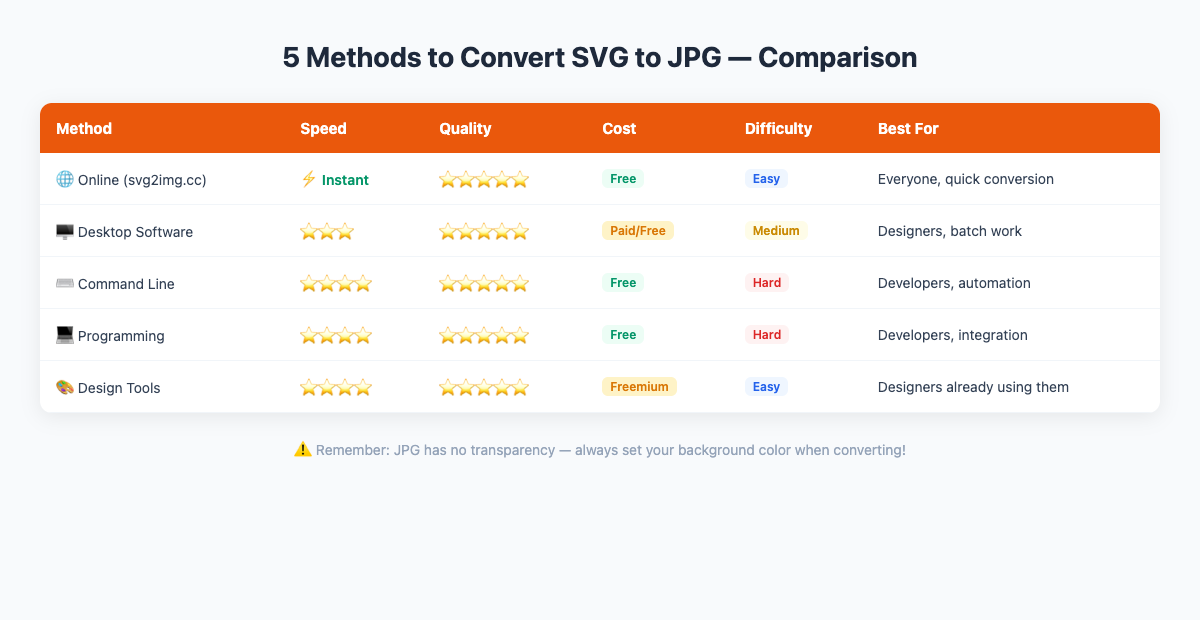
Comparison Table: Which Method Should You Use?
| Method | Best For | Cost | Speed | Quality Control | Difficulty |
|---|---|---|---|---|---|
| Online Tools (svg2img.cc) | Quick, one-off conversions | Free | Instant | High | Beginner |
| Desktop Software | Professional design work | Free–Paid | Fast | Very High | Intermediate |
| Command Line | Automation & batch processing | Free | Fast | High | Advanced |
| Programming | App integration, custom pipelines | Free | Varies | Full Control | Advanced |
| Design Tools | Design workflow integration | Free–Paid | Fast | High | Beginner |
Understanding JPG Quality Settings
JPG uses lossy compression, meaning some image data is discarded to reduce file size. The quality parameter controls this trade-off:
Quality Parameter (0–100)
- 90–100: Visually lossless. Best for professional use, but file sizes are larger.
- 70–89: Excellent quality with good compression. The sweet spot for most web use.
- 50–69: Acceptable for thumbnails or small images. Compression artifacts become visible.
- Below 50: Noticeable quality degradation. Only use when file size is the absolute priority.
Pixel Dimensions and DPI
For web and screen use, the exported pixel dimensions matter more than the DPI metadata. A 1200 px wide JPG will display with the same screen detail whether its metadata says 72 DPI or 300 DPI. For print workflows, DPI becomes useful because it connects pixels to a physical size.
- Web and email: export at the actual display size, or 2x for HiDPI screens.
- Slides and documents: export at the size the image will appear in the document.
- Print: calculate pixels from physical size and target DPI. A 4-inch-wide logo at 300 DPI should be rendered at 1200 px wide.
A common mistake when converting SVG to JPG is rendering too few pixels before applying JPG compression. Since SVG is scalable, render at the pixel dimensions your final use needs, then choose an appropriate JPG quality setting.
Tips for Better SVG to JPG Conversion
1. Always Set a Background Color
This cannot be overstated. SVG files typically have transparent backgrounds. When converting to JPG, you MUST specify a background color — otherwise, transparent areas will default to black or white unpredictably. Choose a color that matches where the image will be used.
2. Use High Quality for Vector Content
SVG line art, text, and sharp edges are actually the worst case for JPG compression. The lossy compression can introduce artifacts around sharp transitions. Use quality 90+ for logos and illustrations. For photographic or gradient-heavy SVG content, quality 80–85 is usually sufficient.
3. Choose the Right Resolution
Convert at 2x the display size for web when the image must look sharp on Retina/HiDPI screens. For print, calculate the pixel size from the physical print dimensions. A 4-inch-wide logo at 300 DPI needs to be rendered at 1200 pixels wide.
4. Embed Fonts Before Converting
If your SVG contains text with web fonts or custom fonts, the converted JPG might render the text incorrectly if those fonts aren't available. Convert text to outlines in your SVG editor before conversion, or use a converter that handles font embedding.
5. Test on Both Light and Dark Backgrounds
Since JPG flattens transparency, test your output against both light and dark backgrounds to make sure your chosen background color works well in context.
FAQ
Will I lose quality converting SVG to JPG?
Yes, but it depends on your settings. SVG is a lossless vector format, while JPG uses lossy compression. However, by using a high quality setting (90+) and sufficient pixel dimensions (2x display size for web, or print dimensions calculated from the target DPI), the quality loss will usually be hard to notice. The main concern is JPG's inability to represent transparency, not only compression artifacts.
How do I set the background color when converting SVG to JPG?
In svg2img.cc, there's a dedicated background color picker in the conversion settings. In ImageMagick, use -background white -flatten. In JavaScript Canvas API, use ctx.fillStyle = '#ffffff'; ctx.fillRect(0, 0, width, height); before drawing the SVG. In Python, composite the RGBA image onto a solid color background using Pillow.
What DPI should I use for print?
For professional print output, use 300 DPI at the physical dimensions of the final printed piece. For example, if your image will be printed at 5×7 inches, render the SVG at 1500×2100 pixels (5×300 and 7×300). For large-format printing (banners, posters), 150 DPI is often sufficient since viewing distance is greater.
Can I convert SVG to JPG on my phone?
Yes. Browser-based tools like svg2img.cc work on mobile browsers — simply open the site, load your SVG, and convert. Since the processing happens client-side, it works on phones and tablets without any app installation.
Why does my converted JPG have a black background?
This happens when the converter doesn't properly handle SVG transparency. JPG doesn't support alpha channels, so transparent pixels default to black (or sometimes another color depending on the rendering engine). Always explicitly set a background color when converting to JPG. Tools like svg2img.cc handle this automatically by letting you choose your background color before conversion.
Conclusion
Converting SVG to JPG doesn't have to be complicated — but there's one rule you should never forget: always set a background color, because JPG does not support transparency.
Whether you need a quick one-off conversion or a fully automated pipeline, there's a method that fits your workflow:
- For speed and simplicity, browser-based tools like svg2img.cc are hard to beat.
- For professional quality, desktop software gives you the most control.
- For automation, command line tools are your best friend.
- For integration, programming libraries offer maximum flexibility.
- For design workflows, tools like Figma and Canva keep you in your creative environment.
If you just need to convert an SVG file right now, give svg2img.cc a try. It's free, requires no installation, keeps your files private, and handles the conversion entirely in your browser. No sign-up, no upload, no hassle — just drag, convert, and download.
Put the guide into practice
Convert SVG files locally in your browser without uploading them.
Open converter